Thursday, 2 April 2015

Gostilitsa 2011

My visit, our visit, to Gostilitsa in 2011 was left until late in the season. My walnut trees were just beginning to consider dropping their head splitting bounty, the hops in the garden were just offering up an oddly familiar perfume, the bees were just beginning to snuggle down after a busy summer to begin their slow but inevitable cycle through autumn sleep, coma and death.

I should take a moment to describe the property in a little more detail. For anyone paying attention, the property comprises more than one building. Four in fact, plus a small extension with bread oven, a storage shed thingy and an outhouse. That is, a proper outhouse, for crapping in. If you haven't gleaned at least some of that until now, your device isn't loading images properly.
Three of the buildings were barns and the other, plus the odds and sods were originally residential. After much consideration, the residential property proved just too expensive to renovate for the space returned, so I decided (to the amusement of the locals) to convert the barns into living areas and leave the old house for later and as yet undetermined use.
Converting the barns was, as I have said, a costly affair. My position at work involves amongst other things, the construction of capital investment business cases. I am faintly embarrassed that my own significant capital investment fails on every conceivable criteria. Call it a labour of love rather than an investment. A folly if you will. I will never see a financial return on Gostilitsa. It does look quite nice though. I will, after a lot more work, have a substantial property. At the moment, I have a property in a various states of repair but in short include 5 bedrooms, 5 bathrooms and 3 kitchens/dining areas. Not only have I made the original investment, I have to date replaced I estimate, 40% or the original fixtures and fittings with more yet to do. Such are the risks of overseas investments but I've also been rather careless, slapdash even, in my choice of business partners and false economies. Some time ago, in order to identify the three separate units, I decided to name them, Wellington (after the Duke of Wellington who surely needs no introduction and is the standalone unit with atrium sticky out bit) and the two joined units, Wolseley (after Field Marshal Garnet Wolseley, 1st Viscount Wolseley, the highly decorated and successful Victorian soldier who's service includes the Crimean War, Ashanti and Canadian campaigns, Burmese war, Indian Mutiny, and doomed Egyptian relief of Chinese Gordon. It is the unit on the left as you look at them) and Montgomery (after Field Marshal Bernard Law Montgomery, 1st Viscount Montgomery of Alamein. If you need to Google him then I suggest you take a Webley .38, wander into the garden, place muzzle against head and do the decent thing before starting your research). In truth, the names given to each unit have yet to take a firm hold. Partly because it's easier to refer to 'the one on the left' or 'the standalone' and partly because no-one outside of military history circles really knows what I'm banging on about and I suspect deliberately refuses to join in.

Having now gotten the inside of the properties comfortable at least, more recent trips have focused on the outside with more genuine fun involved and I now have a great working relationship with Keith who generally employs folk to work on the more boring inside bits such as pointing walls.

And so the trip in the fine weather enjoyed in the autumn of 2011, included the installation of a kitchen in Wellington and the construction of a large Risk board in the garden. Actually, with the good weather, we got a hell of a lot done.

A garden Risk board doesn't build itself...


Did this bit myself. Was rather pleased with my efforts.


'Can yer see what it is yet?' (No longer an acceptable quotation sadly)


Tired bunny after a moderately hard day pouring concrete.


Upcycled broken tiles


Oh, come on! It doesn't look too bad for some office worker numpties on their hols does it?


Enjoying the fruits of our creative labour.


Oh yes, and we did a kitchen too.


Gostilitsa 2010

In February 2010, I and my DIY-ing companions paid another visit to Gostilitsa. The excuse was another birthday celebration (a significant one) and we caught the village on the cusp of being snowed in. In the time it took us to get from Sofia airport to the main road turn-off to the village (including the aforementioned scuffle between our car and a rather large lorry coming the other way at some pace) the two of us that made up the advance party emerged into some passably bad weather. About four miles from the village, our Renault Laguna became snowbound. Still in a state of genuine shock from our earlier road traffic trauma, our ashen faces cooled considerably in the blizzarding air and no amount of pushing and revving could shake us free from the ever deepening white stuff.
One phone call and an anxious 15 minutes later, the sturdy figure of an ex-Army Air Corps Helo pilot emerges out of the milky gloom and now dark night. An angel who'd traded his wings in for a 4x4, he towed us the final leg, us being dragged behind our vehicle of salvation like a corpse tied by rope behind a badly panicked horse. After what had already happened earlier in the journey, that we were almost swept over the edge of the road into oblivion several times, struck the pair of us as merely mildly perilous at the time.
Given the lateness of the hour, we went straight to the bar with the angelic Keith to ease our nervous condition. Concluding that our nerves needed a considerable amount of easing, it was really quite late before we opened the door and got a fire lit in the house. After trying and failing to get some water to flow out of the taps and switching on a few lights, the electrics blew. The net result was that we cooked by candlelight on the wood burning heater, burnt the pine floor, ate something cooked drunkenly and appalling and slept cuddled up together around the embers of the dying fire.
I ought for the sake of clarity state that I had my onesie and old army greatcoat on all night. There were no shenanigans.
A rather cold and tetchy Scott and Amunden awoke the next morning, shook the frost from their beards and tried to start enjoying themselves. I don't really remember what that entailed but I don't readily recall the enjoyment bit. A day or two later, the other two partygoers joined us. Through tears of relief at seeing some fresh faces and the prospect of not now having to eat one of my best friends for breakfast, we made some more progress on the house.
The rest of our time was spent playing cards, playing chess, eating birthday cake, varnishing floors, losing tooth fillings (Graphic Designer), being cut badly by axes (Banker), getting burnt by the wood burning stove (Banker), severe stomach upsets (Grocer) and watching a bar fight between expats down in the village square. The last by the way, was quite exciting. When asked for our reaction to the impromptu cabaret, our collective response was a rather nonplussed, 'We don't do volatile', which appeared to be a sentiment appreciated.

As it turns out, the electrics tripped quite a lot in those early days. The problem is, most village Bulgarians rely on one light bulb, a fridge and satellite telly for the ultra-modern. Stick too many electrical appliances on and the whole thing trips out. Doesn't happen in the UK does it? Last time I asked, my place was rated as a small factory by EON in Bulgaria due to the number of electrical gadgets in use. So one has since learnt to be careful. Don't put the kettle AND oven on at the same time (do you know how much juice a kettle draws? It's loads!) Don't have more than 3 lights on when the washing machine is in use etc. There is also a way of fixing the problem should you get it wrong that we learned on this trip (another miracle offered up by Keith). You know the big grey box in the street with lightning bolts on the side? That's right, the locked one with razor wire around it. Well if you ignore the warning signs and mantraps and open it up with the end of a penknife, you can reset the electric yourself. Cool huh!

Snowy alcove.


The entire work force assembled for a group photo. 


It took about 3 minutes to turn the place into student digs. Men left to their own devices don't cope well domestically.


Traditional post-bar Bulgarian dress (no, I don't know what was going on here either).


Bulgarian Landscape

I'd like to talk a bit about what one is likely to see when travelling through Bulgaria. 

It is in a nutshell, poor. The road out of the airport in Sofia into the interior takes one through a gypsy shantytown which isn't the most attractive first impression for the first time traveller. I haven't seen them for a while but I clearly remember the sight of animal skins being stretched out to cure on a washing line type affair a few years ago. They looked suspiciously cat-like to me. No, really. This sole confusing and unsigned exit route, contains as many deep potholes as it does roughly laid tarmac and serves as an exciting rally stage for the similarly maintained main artery across the centre of the country. 
My house lies in the village of Gostilitsa, slap bang in the middle of the country, nestled close to the Northern slopes of the Stara Planina mountain range that effectively splits the country in two, North and South. It is close to the old Bulgarian capital, Veliko Tarnovo, a beautiful ancient city with plenty to recommend it to visitors, although no-one has ever heard of it. Gostilitsa has at its Southern edge, an old Roman settlement and rather than put it in my own words, I'll just rip from Wikipedia in a rare attempt to not rely on hearsay and failing memory alone. 


About two kilometers south of the village are the ruins of the Romanfortress Discoduratera. Built in the second half of the 2nd century AD, it was an important commercial center. It was located on the road from Nicopolis ad Istrum to Augusta Trajana. It also served as a customs station. Its layout conforms to other Roman stations: a square with each of its corners aligned with one of the four cardinal directions. The area of the fortress was roughly 12000 square meters.
In the middle of the 3rd century AD, Discoduratera was destroyed by the Goths. It was later re-built and live there continued on until the arrival of the Slavs. During the Second Bulgarian Empire the village came to live as a convenient place to spend the night in. The name of Gostilitsa is derived from the word gosti (Bulgarian: гости), Bulgarian for guests.

Also from Wikipedia;

Gostilitsa is home to the traditional Bulgarian folklore group Gostilovski Babi (Bulgarian: Гостиловски Баби, Grandma's from Gostilitza). The group has participated in and is a winner of many folklore events including the festival in Koprivshtitsa. As part of their act they recreate many local traditions such as Laduvane, Trifon Zarezan, and Lazaruvane. Most-colorful however is the Ponuda: on Babin Day (Bulgarian: Бабин Ден, Grandma's Day), all women dress as men and walk through the village until they run into a man whom they will then lift and carry around in the air. It is said that men are afraid to go out on that day.

I haven't been around on Babin Day but it sounds fun doesn't it? 

The trip to Gostilitsa from Sofia takes about two hours and is along the only decent road across the Northern half of the country. Half motorway, half single carriageway, it is of patchy quality in places but has over the years improved. I won't dwell here on a near death experience that I and a close friend had in one snow covered nightmare drive but it lingers in the memory with some clarity. Generally, it's a nice drive and you get to see some of the beauty that is comprises the Bulgarian countryside. Mountains covered with pine trees and valleys dedicated to vines and sunflowers are reminders that this is primarily an agricultural nation. But the reason for dwelling on this subject are the incongruous communist era implants in the landscape. Abandoned factories blot the scene, electrical substations and their multifarious wiry tendrils stretch endlessly across an otherwise pristine vista. Cubist Police blockhouses and the like show there was (and remains in part) little room for aesthetic niceties in socialist society. Function over form fully maximised. In some ways it's a shame. It does ruin a good countryside photo. In others, these carbuncles are as much a part of what makes Bulgaria Bulgaria, as the geography, geology, flora and fauna. A reminder of the human mixed in with the natural history. It also offers an insight into who the people are or at least where they have come from. 

The final mile of the drive always makes me smile. the view over the valley over which Gostilitsa presides is stunning and to see it means I'm nearly there. A few minutes from my home abroad. 

Practicality over aesthetic every time. 
Veliko Tarnovo


Gostilitsa 2009

It's 2009, the recession is now in full flood, my budget has been reduced to nothing and the old place has had a chance to dry out, plumbing patched up and ready for another lick of paint.

Unskilled Bulgarian labour runs to about 20levs per day. That's about a tenner give or take. Even at that price, I was unwilling and in all honesty, unable to afford too many days of uncertain productivity at a local level. I decided therefore to engage a team of moderately skilled UK based labourers on a short term contract. A long weekend to be exact. I can't recall how I pitched the idea to this small group of unenthusiastic DIY-ers but it wouldn't surprise me if it was down the pub one Saturday night and involved a romantic over-promise of exotic adventure and cultural improvement.
All three of my friends fairly leapt (dubiously in truth and with a deal of huffing and puffing from at least one of them - he knows who he is) at the idea. A trip to celebrate my February birthday in a far off land was thus conceived.

The upshot was a cold, muddy and generally primitive weekend which included barbecuing pasta bolognese in the snow. We fixed a few things, broke a few more, but as usual and with minimal persuasion, ended up agreeing the weekend had been a triumph. The first of many to date.

A road trip from the UK to Bulgaria followed in the summer which saw further progress. It was this trip that really saw the place move from habitable towards homely. The plumbing crashed again and resulted in a naked garden shower under a perforated bucket of water, more creative barbecuing, shaving in a washing-up bowl, failed electrics etc. etc. but it was at least three steps forward and only two back. Progress!

A third trip in October saw the addition of a new element in the Bulgarian equation. I had up until this point heard about, but never come across other Brits in the village. I'd been told it was a popular village with expats but I'd spent so much of my time painting, varnishing, assembling furniture and basically working, I'd never really made it out of the grounds to take a look around. After a brief email exchange prior to the trip, I met with Keith and Angie. These names will crop up again in these pages and always in glowing terms but in short, both Keith and Ang have been a mine of information, great company and help since our first introduction. I'll say no more, I'm not prone to gushing.

BBQ in the snow.


A fairly typical evening scene after a day of grafting. Smurf headgear indoors is a legal obligation in post-communist Bulgaria. The toilet roll on the table is more of a mystery but facilities were limited, so maybe we had to..... no, surely not.


The hot water tank fell off the wall. Just, fell off. Rather than help, I decided to take pictures of the affair. 


The garden required a bit of light weeding during the summer trip.


Chernobyled.


Ta-Daa!


It's a Jungle out there.


I can't tell you how much I hurt getting it into this state.


The beginnings of a home.


Gostilitsa 2008

Until 2008, my visits to the village had been with contractors or estate agents and been fleeting affairs. A chance meeting with an expat turned into a commercial arrangement for him to get the place up to a habitable standard (construction of rooms, plumbing, stairs, septic tank etc.). My eye for detail, or lack thereof and trusting nature led to an ultimately poor deal on my side.
I booked a trip with the expectation of staying in the house for the first time and the standard that greeted me upon arrival disappointed. Stairs installed but constructed of rough timber and wonky, hardboard doors, cheap Chinese plumbing, leaking bathroom tiling, the whole thing had been done in a hurry and with the cheapest materials possible. Not only that, the level expertise shown fell somewhat short of artisan. To this day I don't know if monkeys fall under Bulgarian employment legislation but I have a strong suspicion that a troop of chimpanzees had a fine time hammering and sawing their way through my generous budget in early 2008.

Perching a pair of heavily tinted rose coloured spectacles at the end of my nose, I pushed on with painting over the large cracks and pretending that I'd got a result. A few days of hard graft and many cups of tea later, walls were painted, a bed bought, and a construction site started to look more like a home.
A few days after that, the plumbing blew up spectacularly and the place became soaked and uninhabitable.

The evening sun showed the place off to good effect without seeing the unwanted indoor swimming pools.


King Canute didn't have a blue bucket I don't think, but my challenge proved as futile despite the mop and bucket.


Fortunately, the view changed little.


Bulgarian People

I'll take a short break on house progress there to give you a bit more info on Bulgaria itself. In this case, I'll concentrate on the people.
As usual, it will be from my own perspective and full of dodgy facts, so if you really want to know the actual facts, move on. I have no intention of cross-referencing my material for accuracy. This is for me, not you, so it's my truth that matters.

Bulgaria is a country of around 8 million inhabitants, roughly the size of England. So an actual fact is, it has lots of space to play with. There has been a trend of outward migration since the fall of communism in late 1989 (I did look that up to be fair). This accelerated in the 1990's and hasn't really stopped - although I would contend that the much feared Bulgarian invasion of the UK has yet to materialise (they don't revere us that much). The population of Bulgaria is in general decline.
There has also been internal migration to urban centres over the period and what this has all led to is a desertion of many Bulgarian villages.
Schools, doctors surgeries, bus routes, local stores have all diminished or ceased to exist in several locations and loss of this critical infrastructure mass has provided the catalyst for the complete collapse of entire communities. This is not good for rural property prices but more importantly, the ability of the few remaining inhabitants to survive on any level above subsistence. In some cases, subsistence simply represents the status quo and they don't notice much practical difference. In others, no children, no healthcare and no transport equals a miserable deterioration for people used to a comfortable, if frugal, isolated bliss. Laissez faire has been a historical passion for agrarian Bulgarians for centuries. Wars, politics, consumerism, have all been studiously and consciously ignored by generations. Chickens, vegetables and hooch distillation takes primacy in the lives of many. This has all been placed in jeopardy as a result of entry into a democratic, mobile, European Unionised modern world. And you think we have social problems in the UK?? Try being a completely isolated pensioner living off fuck all in a Bulgarian village!

So how does all this affect the nature of an average village Bulgarian? Well at face value, you'd think quite a bit. At first glance, they can appear a bit surly. They appear to stare at you without greeting or smiles. It can in truth be intimidating. They are in fact, curious. Interested. They wonder a lot. Under a fairly thin veneer of apparent hostility, they are in fact very open to discussion (if one is capable in Bulgarian - they don't as a rule speak English in the sticks) and incredibly warm and hospitable. Gifts are commonplace, kisses are frequent and platonic, hooch is freely distributed and almost compulsory between the hours of 6am and 11pm. If you don't receive a parcel of eggs, honey, a random lunch, homemade wine, cherries, peaches, plums, cucumbers or walnuts, then you've pissed someone off pretty badly. I'm probably the worst person I know for mixing with my neighbours and I've had packages of all the above at some point or other. Whatever they've got, they'll share if you give a little. And I ought to give a little more if I'm being honest with myself. My only excuse is that I tend to go there to escape, not engage. It's very selfish of me, but the truth. What can I say?

I think I'll leave things there for now. I'll come back to the people of Bulgaria again but that gives you an idea.

Gostilitsa 2007

I bought my place in 2004 (actually well into 2005 by the time the paperwork got sorted out). As you will have seen, it was in quite rustic condition. And basically, I left it in that state for a year or two.
Several broken relationships later, I decided it was time to do something with my country pile.
The choice of available and reliable contractors in Bulgaria has improved over time but in 2005/6, options were limited. I engaged the one firm that showed any vague degree of competence and they started bringing the place up to scratch. It was expensive by local standards but finding a Bulgarian builder on the net in those days was hard work. Finding one that you trusted with your hard earned, was frankly a pipe dream.

Work began in the summer of 2007.


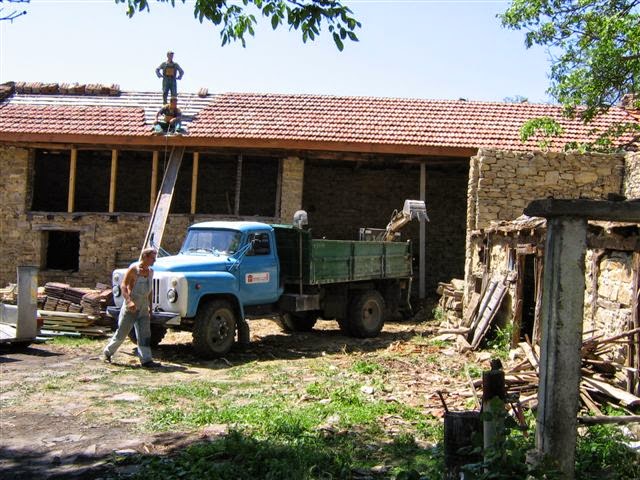
In November 2007, I went back for a visit, to see how they were getting on.